
Growing a business and scaling a business are two different things.
Growth can come from more customers, higher sales, or a successful campaign. Scaling is about building a system that can support consistent growth without costs, effort, and complexity increasing at the same pace.
This is where a strong marketing strategy becomes important.
Many businesses invest in social media, paid advertising, SEO, content marketing, and email campaigns. But when these activities are done without a clear direction, the results can become inconsistent. The business may be doing more marketing but still struggle to generate predictable revenue.
Marketing Without Strategy Creates Random Results
Posting regularly or running more ads does not automatically lead to business growth.
Without a strategy, businesses often move from one marketing trend to another. They may focus on social media one month, increase ad spending the next, and then switch to influencer marketing or SEO.
The issue isn’t always the marketing channel. It’s the lack of a clear plan.
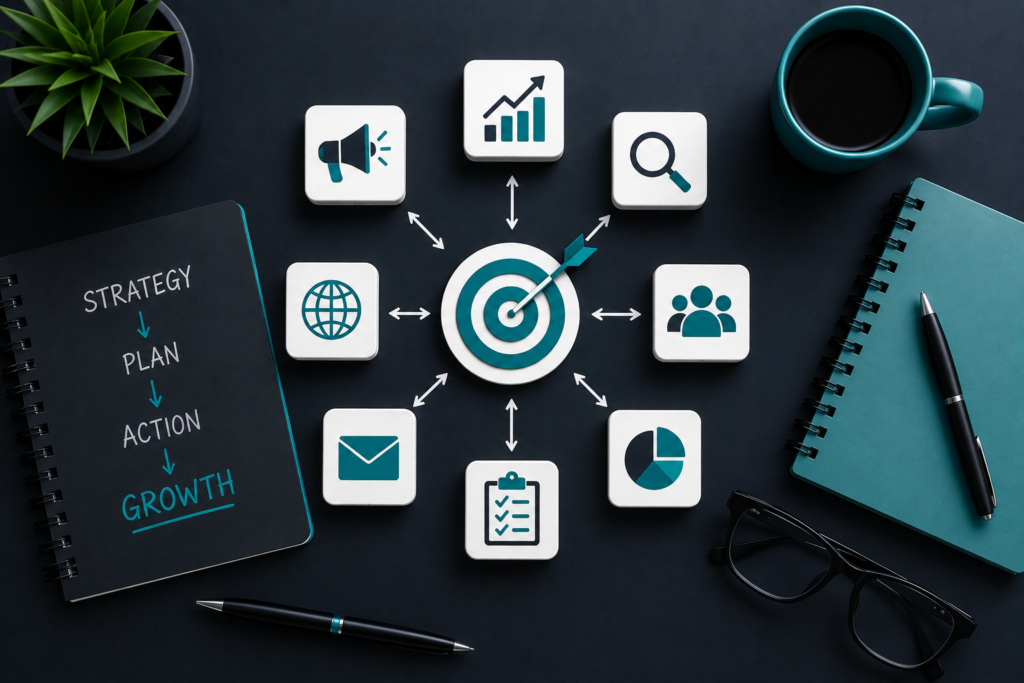
A good marketing strategy connects every activity to a business goal—whether that is generating qualified leads, increasing sales, entering a new market, or building brand awareness.
Scaling Requires Predictable Lead Generation
A business cannot scale consistently if customer acquisition depends only on referrals or occasional successful campaigns.
A strong strategy helps businesses understand:
- Who their ideal customers are
- Where those customers spend their time
- What problems they need to solve
- What influences their buying decisions
- Which channels reach them effectively
- What turns prospects into customers
Once these elements are clear, businesses can build repeatable marketing systems instead of relying on luck.
At Bold Theory Digital, we focus on connecting marketing activities with measurable business objectives rather than treating every campaign as a separate effort.
More Marketing Spend Doesn’t Always Mean More Growth
One common mistake businesses make is assuming that increasing the advertising budget will automatically increase revenue.
But if the targeting is wrong, the landing page doesn’t convert, or the sales process isn’t effective, spending more can simply increase wasted spend.
Before increasing a marketing budget, businesses should understand important metrics such as cost per lead, conversion rate, customer acquisition cost, return on ad spend, and customer lifetime value.
These numbers help determine whether a marketing system is actually ready to scale.
Marketing and Sales Need to Work Together
Marketing can generate hundreds or thousands of leads, but that doesn’t guarantee growth.
If the leads aren’t qualified or the sales team isn’t prepared to convert them, opportunities are lost.
A scalable marketing strategy connects marketing and sales. Marketing needs to understand what makes a lead valuable, while sales can provide insights about lead quality, customer objections, and buying behaviour.
This feedback can then improve campaigns, messaging, targeting, and the overall customer journey.
Scaling Requires Consistency
Successful businesses don’t build their growth around one viral post or one successful campaign.
They build systems.
That means having consistent messaging, clearly defined audiences, reliable lead-generation channels, strong conversion processes, and regular performance analysis.
Over time, these systems make marketing more predictable and easier to improve.
Data Should Drive Marketing Decisions
A good strategy also changes the way businesses look at data.
Instead of asking, “How many people saw our campaign?”, businesses should ask:
Did it generate qualified opportunities?
Which channel brings our best customers?
Where are prospects dropping out of the funnel?
What should we change based on the results?
These questions turn marketing data into meaningful business decisions.
The Bottom Line
Businesses often struggle to scale not because they lack marketing channels, but because those channels aren’t working together toward a clear objective.
A strong marketing strategy creates direction, consistency, measurable goals, and a repeatable path from awareness to revenue.
If your business is spending more on marketing but still doesn’t have a predictable system for generating and converting customers, the problem may not be your budget.
It may be your strategy.
At Bold Theory Digital, we help businesses move beyond scattered marketing activities and build structured strategies designed around their growth goals.
Every brand needs a theory.